Daily rotation and the celestial equator
The sky appears to move in two distinct ways at once, and recognising this is the key to understanding everything that follows.
The first of these motions is that the whole sky appears to turn from east to west once a day. Every star, the sun, and the moon are all carried along together by this rotation. It happens smoothly and at a steady rate, and it turns the sky around a fixed pair of poles of rotation: the northern and southern poles of rotation we met earlier.
If you trace the path of any object as it is carried by this motion, it moves along a circle parallel to every other such circle; together these parallel circles are centred on the same pair of poles. We know that stars close to the pole trace small circles and never set, while stars further from the pole trace larger and larger circles and spend part of their journey below the horizon.
Five stars at different distances from the pole, all carried by the daily rotation. Drag the slider to advance time and watch the hour counters: a star on the equator spends exactly 12 hours above the horizon and 12 below. A star near the visible pole never sets at all. A star near the opposite pole never rises.
This pattern leads naturally to a question: how far from the pole can these circles get? The answer is that there is a largest possible circle, which is halfway between both poles so that it divides the sphere into two equal halves. This is the celestial equator.
Seeing the celestial equator
The equator has a distinctive observational signature. Every star traces a parallel circle once a day, but not all stars spend the same amount of time above the horizon. Stars near the visible pole are up all day; they never set, not even during the day. Stars a little further from the pole do set, but they spend more time above the horizon than below it. Stars very far from the pole barely rise before sinking back down. The equator is the dividing line: a star on the equator spends exactly as long above the horizon as below it. This is true no matter where on earth you observe from.
There is a second way to notice the equator. Because all of the parallel circles complete one full rotation in the same amount of time (one day), but some circles are much larger than others, objects on the larger circles must sweep across more sky in the same period. A star near the pole appears to move slowly; a star further from the pole moves noticeably faster. The equator, being the widest circle, is where this apparent motion is fastest. If you watch two stars at different distances from the pole, the difference in their speed across the sky is plainly visible.
When the sun's own slow apparent motion places it on the line of the equator, the same thing happens to it as to the star on the equator in the diagram above: it is carried along the equator's circle for that day, splitting its time equally between twelve hours above the horizon and twelve below. Day and night are each exactly twelve hours. This is why the circle is called the equator, from the Latin aequus, equal. This happens only on two days a year, at the spring and autumn equinoxes; we will see why in the next chapter.
The equator also gives us something essential for everything that follows: a reference line. Before identifying it, the sky is just a dome of moving points between two stationary poles. Once you know where the equator is, you can describe the position of any star by how far it sits from this line, and you can begin to measure the sky rather than merely watch it.
Practical astronomy: a map of the sky
This is the point at which the sky becomes geometry. The sphere now has poles, an equator, and parallel circles: the same elements as a circle with a diameter. And this is precisely how Ptolemy proceeds. From here on, the Almagest moves into diagrams and mathematical reasoning, working with the sphere as an abstract geometrical object. The surviving manuscripts contain drawn diagrams of circles, arcs, and labelled points: looking at them, one can "see" the sky and the earth. This website tries to do the same thing, but with interactive 3D models that recreate something closer to the intuition of actually watching the sky.
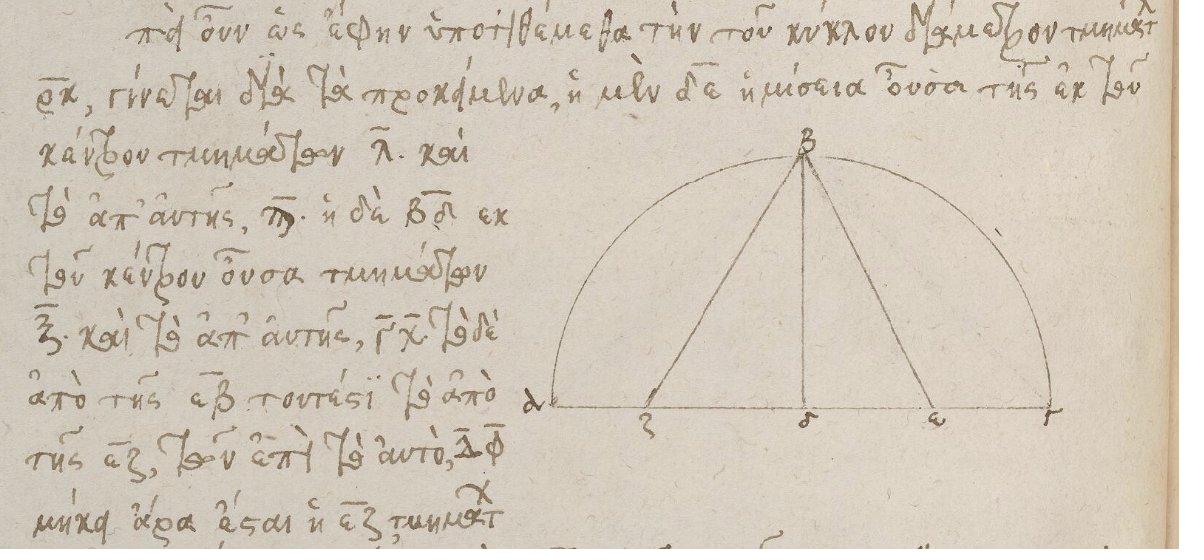
A geometrical diagram from a Greek manuscript of the Almagest (Cambridge, Queens' College, MS 32). This manuscript dates from the 16th century, many centuries after Ptolemy wrote; the diagrams have been copied and redrawn by generations of scribes, and may differ from whatever Ptolemy originally drew.
A Copernican update
Ptolemy describes all of this as a real physical sphere turning around the earth. In his view, the celestial equator is literally the widest part of the celestial sphere of fixed stars (the firmament, the rigid shell on which the stars are fixed), and stars on it travel faster because they have more ground to cover, just as a point on the rim of a wheel moves faster than a point near the hub.
The heliocentric explanation is quite different. The stars are not moving; the earth is spinning. The parallel circles and the equator are not features of any physical sphere: they are artefacts of how the earth's rotation changes your line of sight.
Two views of the same phenomenon. Above: in the heliocentric view, the earth rotates inside the fixed celestial sphere. A point on the geographical equator (yellow dot) traces the celestial equator (white line) on the sky as the earth turns. Orion, fixed on the celestial sphere, appears to pass overhead. Below: in the observer's view from the ground, it is the sky that appears to rotate. Orion rises from the east, crosses the sky, and sets in the west; the path it follows along the celestial equator depends on the observer's latitude. Use the latitude slider to see how the angle of the celestial equator changes.
Both models predict identical observations. Ptolemy: a rigid sphere has wider and narrower parts. Copernicus: rotational perspective displaces objects more when they are further from the axis.
Imagine: spinning on the spot
To feel the Copernican explanation in your bones, imagine standing in a room and spinning on the spot. A lightbulb on the ceiling directly above you is close to the axis you are turning around, so it barely seems to shift. A picture on the far wall is perpendicular to your axis, so it sweeps past dramatically. Neither the bulb nor the picture is moving; the apparent speed is entirely about the angle between each object and your axis of rotation.
That is exactly what happens with stars. The "pole" is the direction your axis points, and the "equator" is the plane perpendicular to it. Objects near the pole barely move; objects on the equator race past. No sphere is needed.
Try moving the latitude slider in the diagram above and watch what happens to the horizon in the lower panel. As you move the observer north or south, the whole disk tilts: the pole climbs higher or sinks lower, and the celestial equator changes its angle in relation to the ground.
But notice something surprising. The celestial equator always crosses the horizon at the same two points, one on each side. The horizon pivots around those two points as if on a hinge. You might expect that travelling north on the earth would carry you "above" the celestial equator, so that it would shift southward in the sky. It does cross the sky further to the south, at a lower angle; but it meets the horizon itself at the same pair of opposite points no matter where you stand. This is a consequence of what we saw in the previous chapter: the earth is negligibly small compared to the celestial sphere, so moving across its surface does not displace you relative to the sky in any measurable way.